Bitcoin ETF Sees First Outflow Since February as Funds Shift to Layer 2

US Bitcoin spot ETFs have recorded their first net outflow since mid-February, marking a significant shift after a period of consistent inflows. In the week ending March 27, these ETFs saw a total outflow of $296.18 million, with a substantial $225.48 million exiting on March 27 alone. This trend suggests a potential rotation of capital, with analysts noting some funds may be moving towards Bitcoin-based infrastructure projects, commonly referred to as Layer 2 solutions.
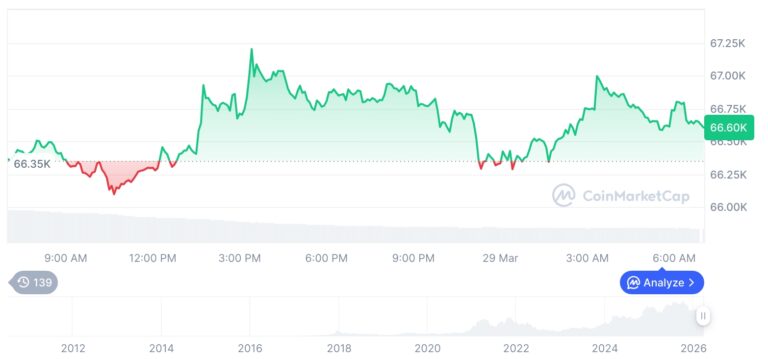
This outflow occurred as Bitcoin prices dipped below $65,000 before recovering to the $67,000 range. The move signals a cooling of immediate institutional demand for spot Bitcoin ETFs, a key driver of the cryptocurrency’s price surge earlier in the year. For traders, this suggests a need to monitor on-chain data for evidence of capital reallocation, as Layer 2 solutions could benefit from this trend.
Asian Market Signals: Broader Economic Headwinds
Beyond the crypto market, broader economic and geopolitical factors are influencing investor sentiment, with notable impacts on Asian markets. South Korea’s semiconductor giants, Samsung Electronics and SK Hynix, experienced significant stock price declines. Samsung fell 1.89% to 176,300 KRW, and SK Hynix dropped 5.31% to 873,000 KRW. This downturn is attributed to rising geopolitical tensions in the Middle East and a new technology announcement from Google, indicating a fragile global risk appetite.
In parallel, the Korean government is discussing potential increases to property holding taxes as a measure to stabilize the real estate market. This move, aimed at curbing speculative investment, highlights regulatory approaches in Asia that can influence broader asset flows. While seemingly distinct, these traditional market pressures can indirectly impact crypto investor sentiment by tightening liquidity or shifting focus away from risk assets.
Meanwhile, in the US crypto space, a lack of understanding regarding tax principles among investors is causing confusion, particularly with the potential introduction of Form 1099-DA. A survey revealed that less than half of crypto investors fully grasp that taxes are levied at the point of sale. This regulatory uncertainty in major markets like the US could further encourage capital flight to regions with clearer or more favorable regulatory frameworks, or to assets perceived as less susceptible to immediate tax implications.
Solana (SOL) has shown a minor rebound, rising 2.45% to $84.36 after four consecutive days of decline. However, market experts remain cautious due to decreasing open interest and a prevailing sense of fear, with limited catalysts for significant upside without clear ecosystem updates. The key level to watch for SOL is breaking and holding above the $84 resistance.
What to watch: Monitor the sustained flow of capital into Layer 2 solutions and any further regulatory clarity from major economies like the US and South Korea. The interplay between geopolitical stability, traditional asset performance, and crypto-specific developments will be crucial.
Disclaimer: This article is for informational purposes only and does not constitute financial advice. Always do your own research (DYOR) before making investment decisions.